



 @c6reviews.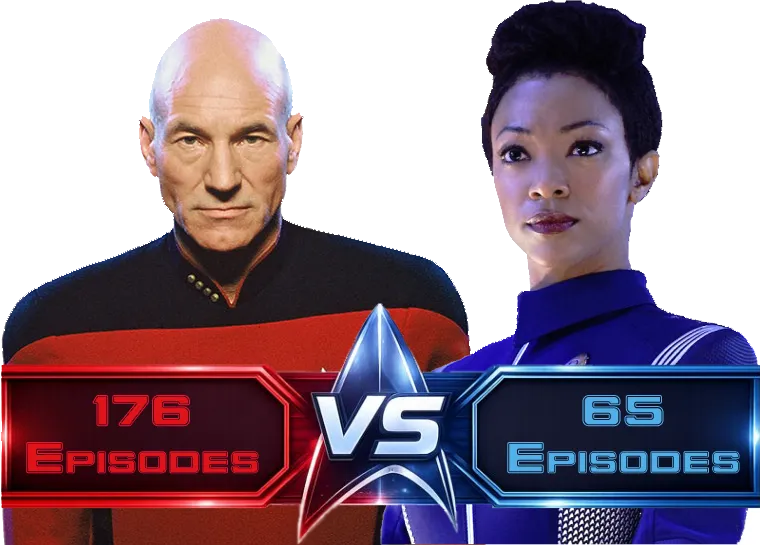
Will the latest generation of Star Trek (2017–present) ever be something that people go back to and re-watch, 25 years later, with fond memories? Many people call this era the “Kurtzman Era” of Trek, named after executive producer Alex Kurtzman. The era starts in 2017 with the premiere of Star Trek: Discovery, and it continues as we head into the era's 10th year, 2026, with the premiere of Star Trek: Starfleet Academy set for January 15. Though “Kurtzman Era” may accurately describe the leadership of the franchise in this time, I don't like using that name because it lends itself to blaming all of the franchise's shortcomings or missteps on one person, which simply isn't fair, just as it's not fair to associate all of its successes with one person. I prefer to call this “Third Generation” Trek so as not to lay all the responsibility on a single person.
(There is another term to describe the current era of Trek, used pejoratively by folks who – in my opinion – can not or will not allow themselves to appreciate post-2005 Star Trek. You can be sure that anyone who calls it “nuTrek” does not have anything positive to say about its Third Generation offerings.)
Anyway, I was just thinking about the “Second Generation” of Trek, and how the “Big Three” (my term) – The Next Generation, Deep Space Nine, and Voyager – have a grand total of 517 episodes among them. Over their 15-year run (1987–2001), that's an average of over 34 live-action episodes per year. These are a treasure trove of memories that I can play 25 years after they've gone off the air and still enjoy them, with enough episodes to watch one each day and last nearly a year and a half without repeats.
If we add up all the episodes from Discovery, Short Treks, Picard, Lower Decks, Prodigy, and Strange New Worlds that aired between 2017 and 2025... that's a total of 214. Over that 9 years, that's only 24 episodes per year (rounding up), and let's keep in mind that 90 of those are animated, 30-minute offerings instead of a full hour. If we exclude those, we've only been getting 14 live-action episodes per year. Will people still be bingeing these in 2050?
The difference is, of course, that the Star Trek episodes that have aired since 2017 have often been gorgeous, movie-quality productions with impressive special effects. Obviously, it takes more time and more money to maintain that quality, and that means having fewer episodes than their 90s counterparts. Some of this is out of necessity! The 90s shows were all broadcast in standard definition. (Star Trek: Enterprise's 3rd and 4th seasons were the first to be filmed in HD.) HD televisions did not become even close to mainstream until around 2006. So, in the days of standard definition broadcasts, it was easier to get away with lower-quality sets and costumes, because any tiny imperfections wouldn't even be visible to audiences. When Trek-on-TV started back up in 2017 after a 12-year hiatus, HD televisions were now in a majority of US homes, so it became necessary for the show to produce higher-quality sets, props, costumes, etc. since tiny details would be visible and any imperfections would be scrutinized.
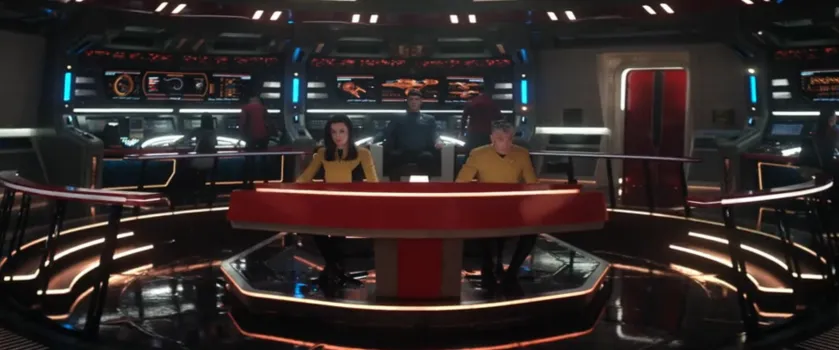 Why would you cancel this?!
On the other hand, once a primary set is built and costumes are tailored for the main cast, those costs are sunk, so why not get as much use out of them as possible? I look at gorgeous sets like the bridge of the Enterprise in Strange New Worlds and it seems a shame that it will only see 46 episodes on-screen before that production ends and the set is torn down. Third Generation Trek does “quantity” in a different way: more shows. While the seasons and series have fewer episodes than they used to, there is a larger variety of shows and genres to choose from, and this seems like it will continue to be the trend going into 2026. I'm no expert, but this strategy does seem to be more in line with the television/streaming industry of this time, so it's a move that makes sense – at least from a business perspective.
Take a look at Second Generation Trek by comparison: the “Big Three” (TNG, DS9, and VOY) offer only a bit of variety, with virtually no change in genre. The crew, the location, and the stories may be different, but all three of those series take place in the same 24th-century era. With TNG having turned out to be a success (after the first two seasons), spin-offs were hesitant to change a successful formula. Just look what happened in 2001 when they decided to go an entirely new direction with the prequel-series Star Trek: Enterprise ... they tried something new, and it turned out to be a flop. Enterprise wasn't a complete failure, but it certainly did not live up to its predecessors, and was at least partially responsible for the 12-year hiatus of Trek-on-TV. Some say part of the problem with Enterprise is that the showrunners applied the same TNG formula to a show where it didn't belong, but I'll save that debate for another time.
One thing that I'm afraid will be negatively impacted by the new format is series finales. So far in Third-Gen Trek, we only have two examples of live-action series finales – and they are both bad examples. Star Trek: Picard's series finale can't even properly qualify as a Third-Gen series finale, because it doesn't just wrap up the 3-season show, it serves as a conclusion to a long history of the TNG characters. So that leaves us with Star Trek: Discovery, the only uniquely Third-Gen, live-action Trek show to have started and ended as of this writing. Its series finale is another bad example because they were not prepared for their cancellation, and they had to scramble to add another 30-minutes of series wrap-up to what was only supposed to be a season finale. Regardless of the quality of the rush-job, one thing stood out to me: the tearful embraces and nostalgic reflections on “everything we've been through together” just didn't have any emotional impact for me. We had only seen these characters for 65 episodes, stretched over 8 years. It just didn't feel like such a long and fulfilling journey that had earned those tears and hugs. I hadn't grown to love the Discovery characters as much as I had with the ones from the 90s. Think about going on adventures with your favorite characters for 170 episodes and then having a triumphant finale like Voyager's, or a full nine-episode finale arc like with Deep Space Nine. Now that deserves some hugs and tears!
I am not here to say that either Second or Third Generation Trek is better than the other. They are necessarily products of their time, and we have the benefit of 25 years of hindsight for the Second Generation, but we don't have that for Third-Gen Trek – so who is to say? I'm sure that someone twenty-five years younger than me who is watching Trek for the first time in its Third Generation has a very different opinion than someone twenty-five years older than me who grew up with The Original Series. So I am left with my original question, will folks in 2050 be looking back on today's Trek and feel a great nostalgia for it, having grown emotionally close to the characters? Will they have enough content to keep them entertained, and will it have the same impact? Will they, perhaps, be decrying the shortcomings of Fourth Generation Trek? ◼